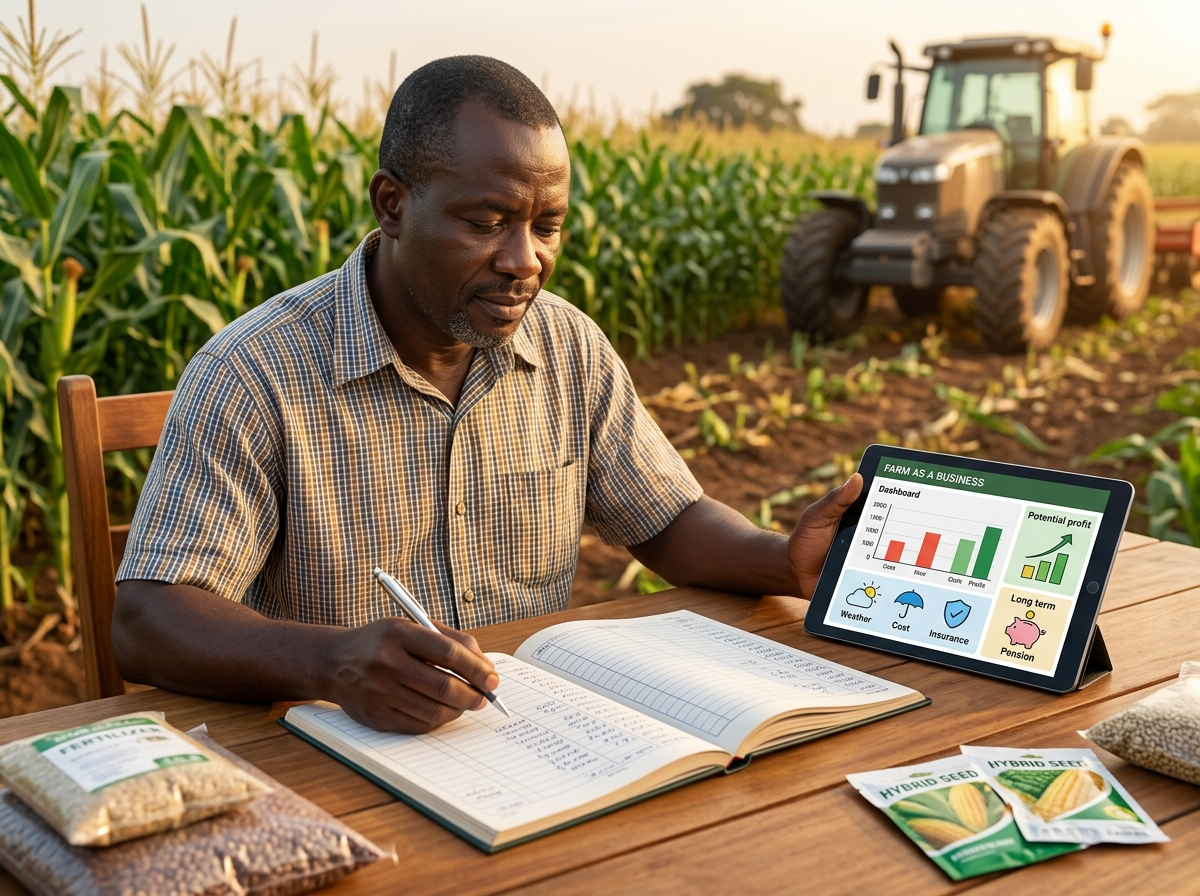
Farming requires hard work, but modern farming requires more than production—it requires business thinking. Learn the 5 essential pillars of farm business management and profitability.
Farming is indeed hard work. But Is It a Business? Yes! Farming requires hard work, early mornings, long days, unpredictable weather, rising input costs, market uncertainty, and sometimes, a harvest that does not turn out as expected. But there is another side of farming that deserves attention. And that is Management. A farmer may produce a good harvest and still struggle financially if costs are not properly tracked. That is why modern farming requires more than production. It requires business thinking. The traditional question might be: “How much did I harvest?” An agribusiness-minded farmer asks: “How much did I make?” There is a difference. Suppose you harvested 100 bags of maize. This sounds impressive, but how much did you spend on land preparation? What did the seed cost? How much went into fertiliser? What did you spend on labour, Transportation, Storage, Pest control, and financing? And after all those expenses, what is left? Understanding the difference between revenue and actual profit is one of the foundations of running a farm as a business. 1. Know Your Numbers You do not have to be a financial expert to start keeping records. Record what you spend, what you produce, what you sell, your debts, and your income. These simple records can help you understand whether your farming operation is growing, stagnating, or losing money. They can also help you make better decisions before the next season. 2. Think About Cash Flow Agriculture has a unique cash-flow challenge. Money often goes out before it comes in. The farmer spends at planting and production stages and may only receive significant income at harvest. This means cash-flow planning matters. If you spend everything from one harvest immediately, what will finance the next production cycle? If you borrow, when will repayment be due? If input prices increase, how will that affect your production plan? These are business questions that the farmer must answer to build and maintain a successful agricultural enterprise. 3. Manage Risk A good business does not only ask how to make money. It also asks: What could make me lose money? For farmers, risks can include drought, floods, excessive rainfall, pests, disease, and other production challenges. Agricultural insurance can form part of a broader risk-management strategy. Agricom's agricultural insurance solutions are designed to protect against several climate and production risks, while its technology approach uses weather and satellite information to support monitoring. The point is not to assume that something will go wrong. Rather, it is to prepare for uncertainty. 4. Use the Right Inputs at the Right Time Productivity depends on many factors, including access to appropriate inputs. But inputs also require cash. This is where financing can become part of farm management. Agricom's Input Financing solution is designed to help eligible farmers access essential inputs at the beginning of the season and repay after harvest. For farmers, the bigger lesson is this: Finance should support production, not simply consumption. When financing is used strategically, it can help a farm maintain its production cycle. 5. Think Beyond One Harvest A successful farm should not only survive one season. It should build towards the next one. That means thinking about reinvestment. It also means thinking about the farmer. What happens when the farmer becomes older? What happens if the farmer can no longer work at the same pace? What happens to the income-generating capacity of the farm? Long-term financial planning, including retirement savings, should therefore be part of the conversation. FarmerCare, Agricom's flexible micro-pension and protection solution, is designed for farmers and informal-sector workers seeking to build long-term financial security. So, whether you are a smallholder farmer, agribusiness owner, or agricultural entrepreneur, building a resilient farm begins with good decisions. Remember, your farm is a business. Plan it like one.
